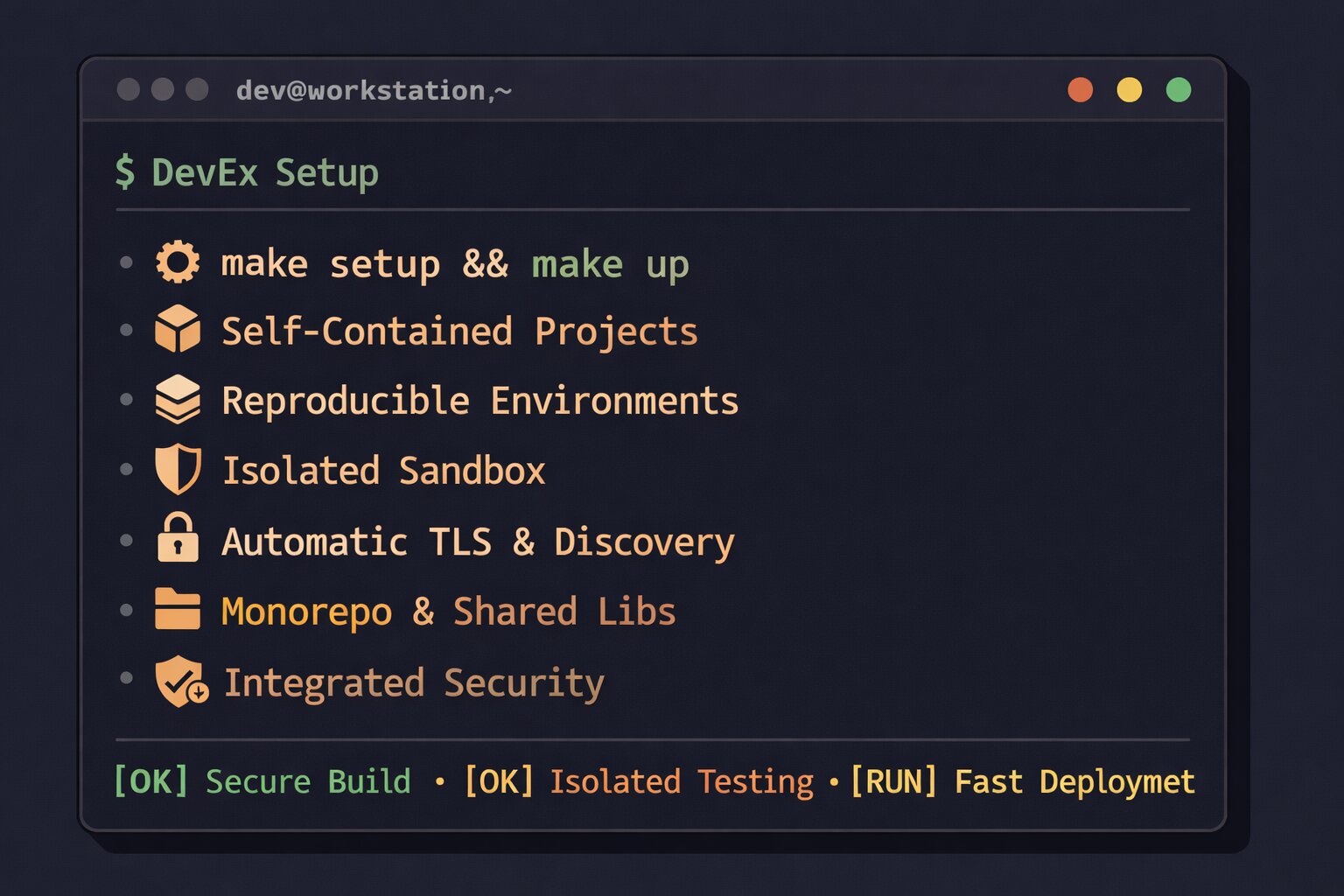
After many years working with distributed systems, regulated environments, and high-criticality platforms, a pattern becomes clear: most discussions around Developer Experience tend to address symptoms rather than root causes.
Many initiatives focus on building internal portals, abstractions, or guided workflows, while the most impactful problems remain part of the developer’s daily experience: inconsistent environments, lack of reproducibility, dependency on other teams, and absence of mechanisms that enforce correctness.
These issues directly affect delivery speed, software quality, and operational risk.
Where friction actually accumulates
If we look at a developer’s journey in a moderately complex system, friction tends to concentrate in a few specific areas.
The first is environment setup. It is common to see different distributions of the same technology behaving differently. In Java, for example, defining a version is not enough. Differences between distributions can lead to subtle and hard-to-debug issues. When combined with operating system differences, such as developing on Windows while running in Linux in production, the result is often unpredictable behavior.
In addition, manual configuration of proxies, certificates, and environment variables is still common. These steps are often poorly documented or rely on informal knowledge shared within the team. This creates a fragile system where onboarding becomes a social process rather than a technical one.
Another recurring issue is the inability to run relevant parts of the system locally. Platforms that only work in cloud environments, with restricted access or high execution cost, limit iteration speed. This becomes even more problematic when local behavior does not reflect production characteristics, especially in scenarios involving concurrency, latency, or load.
Testing also suffers from structural problems. Shared environments, dirty test data, and lack of isolation make it difficult to trust results. In many cases, validating a feature depends on coordination between multiple people, which reduces efficiency.
Documentation, when it exists, is often fragmented and poorly indexed. Corporate tools accumulate content over time without a clear structure. The practical outcome is that finding relevant information becomes expensive, and once again, reliance on people becomes unavoidable.
Security as a system property, not an individual responsibility
Security is often underestimated in DevEx discussions.
In many environments, critical aspects such as certificates, credential management, and secure communication configuration are still handled manually by developers. This introduces friction and assumes a level of human perfection that is unrealistic.
A useful analogy can be made with programming languages. In C or C++, it is possible to write safe code, as long as no mistakes are made. Rust, on the other hand, reduces entire classes of errors by design, guiding developers toward safer patterns.
The same principle should be applied to development environments.
Container images should be pre-approved and already include:
- updated certificates
- enforced security policies
- secure network configurations
- audited dependencies
Developers should not be responsible for configuring these aspects manually.
Build and deployment pipelines should also include security validations that cannot be easily bypassed. This includes vulnerability scanning, dependency validation, and policy enforcement.
Another critical aspect is execution isolation.
All tooling and code execution should happen in environments isolated from the host. This reduces risks such as:
- supply chain attacks
- execution of malicious code
- credential leakage
- cross-project contamination
Containers using Docker or Podman provide a baseline level of isolation. More advanced setups can include sandboxing, lightweight virtualization, or disposable environments per project.
This isolation also solves a practical problem: preventing dependencies from one project from affecting another. Without isolation, conflicting versions of libraries and runtimes often lead to unpredictable behavior.
There is an important balance to maintain. The process of approving images and tools must be fast. New stable versions of languages and frameworks should be available quickly. Otherwise, teams are pushed toward outdated stacks, increasing risk and slowing down evolution.
Effective security requires both enforcement and agility.
What actually works
Across different experiences, some patterns consistently prove effective.
Automated, reproducible, and self-contained setup
Environments where setup is automated and consistently executed significantly reduce onboarding time and initial errors.
An important concept here is treating the project as self-contained. Everything required to run the system should be accessible from the repository itself.
In practice, this can include:
- a Makefile or Justfile with standardized commands
- containers for dependencies such as databases, queues, and caches
- scripts that bring up the full local environment
Example:
make setup
make up
make test
This approach removes implicit knowledge and reduces variability between environments.
For reproducibility, tools such as Nix (with flakes) or Devbox allow declaring all dependencies explicitly.
This means:
- the environment is versioned with the code
- there is no dependency on the developer’s machine state
- moving between machines becomes trivial
This directly addresses environment drift.
Sandbox and isolation by default
Isolation should not be optional. It should be part of the development model.
Running code directly on the host exposes the environment to unnecessary risks:
- vulnerable dependencies
- malicious code execution
- conflicts between projects
- cross-environment contamination
Containers with Docker or Podman address part of this, but can be extended further.
Tools like Distrobox allow you to create fully isolated development environments with controlled integration with the host system. However, some additional configuration is required, as Distrobox defaults are quite permissive, since it was designed with a stronger focus on ease of host integration rather than strict isolation.
Another option is the Qubes OS distribution, which provides a very strong sandboxing model using virtualization based on Xen. However, it requires relatively powerful hardware and comes with a certain learning curve.
This enables:
- independent environments per project
- multiple language versions coexisting without conflict
- safe execution of tools and code
This isolation is also critical from a supply chain security perspective.
Local execution close to real environments
Being able to run a representative version of the system locally changes development dynamics.
Container-based setups allow simulation of:
- dependent services
- basic system topology
- communication flows
Even without full production scale, this removes a large portion of external dependencies from the development loop.
Ephemeral environments and per-developer isolation
The ability to create isolated environments on demand improves both development and testing.
Each developer can run their own instance of the system and dependencies, avoiding conflicts.
This supports:
- parallel feature validation
- elimination of shared environment bottlenecks
- more predictable testing
For testing, ephemeral environments are essential. Creating, using, and discarding environments ensures clean and controlled test data.
Security embedded in infrastructure
Effective security is built into the system.
Key patterns include:
Approved images
Container images should be:
- audited
- pre-configured with certificates
- automatically updated
- centrally maintained
This reduces manual configuration and prevents common mistakes.
Automated TLS and certificates
TLS termination should not be handled inside application code.
A more robust approach uses sidecars or proxies that:
- manage certificates automatically
- handle rotation and refresh
- centralize security policies
This reduces complexity and avoids configuration errors.
Service discovery and communication
Service discovery and communication can also be simplified using sidecars.This allows:
- reduced coupling between services
- standardized communication patterns
- elimination of manual endpoint configuration
Autonomy with well-defined limits
Unlimited autonomy leads to inconsistency. Excessive control leads to bottlenecks.
The balance comes from automation that embeds standards into tooling.
Instead of manual approvals:
- pipelines validate contracts
- templates enforce standards
- infrastructure is provisioned with correct defaults
This removes the need for operational gatekeepers.
Monorepo as a DevEx enabler
In systems with multiple services, monorepo can provide significant benefits.
Visibility
The entire system is accessible in one place, improving understanding and debugging.
Per-developer environments
Having all components available makes it easier to run isolated versions of the system.
Shared interfaces and libraries
Interfaces and shared libraries can evolve together without constant artifact publishing and version management.
This reduces:
- integration friction
- compatibility issues
- dependency management overhead
Conclusion
Effective Developer Experience depends on structural properties:
- reproducible environments
- consistent isolation
- embedded security
- automation with clear boundaries
- reduced dependency on other teams
Self-contained projects, deterministic setup, and isolated execution significantly reduce daily friction.
By embedding security and standards into infrastructure and tooling, it is possible to increase autonomy without sacrificing control.
This approach reduces errors, accelerates delivery, and improves system quality in a consistent way.
That’s all folks!
Artus